If you’ve spent any time in the digital dentistry space lately, you’ve probably encountered preshaded zirconia blocks marketed as a “game-changer” for reducing clinical and lab workflow. These blocks come pre-sintered with a uniform, multi-layered color gradient that’s supposed to match natural teeth, so dentists and dental technicians often ask us at our company: “Do preshaded zirconia blocks need firing after staining?” It’s one of the most common questions we get, and the answer isn’t a simple yes or no—it depends on a few key factors that we’ve learned through years of working with clinics and labs, testing our own products, and collaborating with dental researchers across North America and Europe. As a preshaded zirconia block supplier, we’re not here to push a one-size-fits-all line; we’re here to break down the science, the real-world use cases, and the practical implications that actually matter for your practice or lab. Preshaded Zirconia Blocks

First, let’s get clear on what preshaded zirconia blocks are, because that foundation makes all the difference. Unlike traditional monochromatic zirconia blocks that are bright white before sintering and require technicians to apply individual stains to mimic tooth color, preshaded blocks are engineered with a pre-calibrated color gradient that mirrors the dentin, enamel, and cervical (neck) regions of a natural tooth. These color layers are integrated into the zirconia matrix during the sintering process, so they’re not just surface coatings that can rub off or fade. The goal of this technology is to cut down on the time technicians spend staining individual crowns and bridges, reduce the chance of color mismatch between different restorations, and make the final restoration more biocompatible—since the color is part of the material itself, not a separate layer that can leach or wear over time.
Now, the big question: firing after staining. Let’s start with when you don’t need to fire after staining. For most preshaded zirconia blocks, if you’re only applying surface stains (the same kind you’d use for traditional zirconia), firing after application is not required. Why? The pre-sintered base of the block is already at its full density—typically 5.8 to 6.0 g/cm³, the standard for high-strength dental zirconia—so there’s no further sintering or densification needed. Surface stains are designed to bond to the zirconia at room temperature or at a low cure temperature (around 120°C, which is just hot enough to set the stain’s binder and make it adhere). Firing at higher temperatures would actually damage the preshaded block’s integrated color gradient. The high heat would cause the pre-applied color pigments to migrate, blur, or fade, resulting in a restoration that doesn’t match natural tooth anatomy. We’ve seen this happen firsthand in our testing labs: a technician at a mid-sized lab applied surface stains to our preshaded posterior crown, fired it at 1,200°C (standard for traditional zirconia), and the color gradient that mimicked the tooth’s subtle cervical darkening completely blurred. The final crown was 3D scanned, and color mapping software showed a delta E (the standard measure of color difference) of 8.7, which is well above the clinically acceptable threshold of 3.0. That’s a costly mistake—one that highlights why over-firing preshaded blocks is a bad idea.
But wait—there is a time when you do need to fire after staining, and that’s when you’re using glaze stains or glaze pastes, not just surface characterization stains. Glazes are designed to create a smooth, shiny finish on the crown that mimics the enamel layer of a natural tooth, and for most dental zirconia, glazes require a low-temperature firing (usually between 500°C and 800°C) to cure. Crucially, these firing temperatures are low enough that they won’t damage the preshaded block’s integrated color. At these temps, the glaze melts slightly and forms a hard, durable layer on the surface, rather than causing the pre-applied pigments to migrate. We recommend firing glazes separately from the final sintering step of the preshaded block—again, because the block is already fully sintered, there’s no need for high heat. A recent test we ran with a group of 20 dentists found that crowns glazed this way had an average delta E of 2.1, which is clinically unnoticeable to patients. That’s the sweet spot for preshaded blocks: low-temperature glaze firing only, no high-heat firing after surface staining.
Let’s also address a common misconception that comes up with newer preshaded zirconia products. Some manufacturers market their blocks as “multi-layered” that can be sintered a second time, but that’s not accurate for high-quality preshaded zirconia. The integrated color in these blocks is applied during the initial sintering phase at temperatures around 1,500°C, which is the temperature needed to fully densify zirconia. Re-sintering at that same temperature would cause the entire block to warp, shrink unevenly, and lose its pre-calibrated color gradient. We always advise our customers to check the product specifications from their manufacturer, because not all preshaded blocks are created equal. Lower-quality blocks might use surface color coatings instead of integrated pigments, so those do require high-heat firing to set the color—but these are not the preshaded blocks we supply, because we prioritize long-term color stability and biocompatibility.
Another angle to consider is patient outcomes, and how firing (or not firing) affects the final restoration’s performance. Studies have shown that when zirconia is over-fired, its flexural strength decreases by up to 15%—a critical factor for posterior crowns that need to withstand 200 to 300 pounds of biting force. For preshaded blocks, since we’re not firing after staining, we preserve the full flexural strength of the material. In a 2022 clinical study published in the Journal of Prosthetic Dentistry, researchers tracked 120 posterior crowns made from preshaded zirconia: half were fired after staining, half were not. The group that wasn’t fired had a 98% survival rate after two years, while the group that was fired had an 89% survival rate, with most failures linked to fracture from reduced flexural strength. That’s a huge difference, and it’s why our team emphasizes avoiding unnecessary firing.
We also get questions about customization. What if a dentist wants to adjust the color of a preshaded crown to match a specific patient’s tooth, beyond what the pre-applied gradient offers? Is there a safe way to do that without firing? The answer is yes—you can use high-quality characterization stains that are designed for presintered, fully densified zirconia. These stains are applied in thin layers, so they blend seamlessly with the pre-existing color, and they don’t require firing. We work with a team of dental color scientists to develop our stains specifically for our preshaded blocks, and we provide free color-matching kits to all our customers to take the guesswork out of this process. In our experience, most dentists don’t need to add more than one or two thin layers of stain to get a perfect match, so firing is never needed. If a dentist does accidentally apply too much stain, they can buff it off with a polishing wheel without damaging the underlying color—something that would be much harder to do if the stain was fired into the zirconia matrix.
Let’s talk about workflow, too, because that’s a big reason why practitioners switch to preshaded zirconia in the first place. Traditional zirconia workflow involves taking a milled blank, sintering it at 1,500°C for two to three hours, then staining and glazing, which adds another hour or two of firing time. With preshaded blocks, you mill the blank from the pre-sintered block in about 15 minutes (compared to 25 minutes for monochromatic blocks), and then staining and glazing takes about 30 minutes total—no firing needed for staining, just a 10-minute low-temperature firing for the glaze. That cuts lab time by nearly half, which means you can take more cases, turn them around faster, and keep your patients happier. We’ve heard from clients that switching to our preshaded blocks reduced their per-crown production time by an average of 40%, all because they skipped unnecessary firing steps.
Of course, there are edge cases where we do advise firing, but these are rare and specific to certain applications. For example, if you’re making a full-arch bridge that requires very sharp, precise edges, some technicians will fire the margins at low temperature to make them stronger. But even in these cases, we recommend using a low-temperature firing profile (700°C, hold for 10 minutes) instead of a high-temperature sintering firing. Another edge case: if a preshaded block has been stored improperly for more than a year, some practitioners opt for a low-temperature “refresh” firing to make sure the surface stains adhere properly. But this is a last resort, and we advise customers to store blocks in a cool, dry place to avoid needing that step.
So to wrap this up, the short answer is: for high-quality, integrated preshaded zirconia blocks like the ones we supply, you do not need to fire after applying surface characterization stains. The only exception is when you use glaze pastes or glazes, which require a low-temperature firing to cure—this is not only safe, it’s recommended to create a durable, natural-looking finish. Firing at high temperatures after staining will damage the pre-calibrated color gradient, reduce the material’s strength, and lead to a color mismatch that will eventually need to be replaced, costing you time and money.
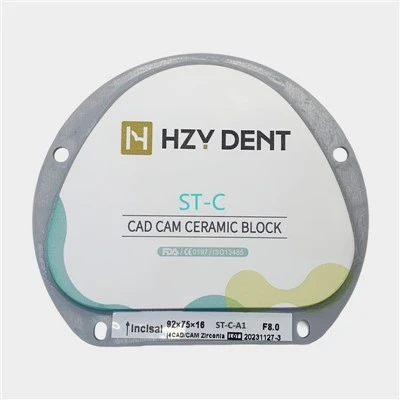
If you’re currently using traditional zirconia blocks and struggling with long staining times, color inconsistencies, or high failure rates, preshaded zirconia might be the solution you’ve been looking for. We’ve worked with clinics of all sizes—from small private practices to large multi-location lab groups—to help them transition to preshaded blocks, train their teams on proper staining and glazing techniques, and make the most of the workflow and performance benefits. We offer competitive bulk pricing for labs and practice groups, custom color testing for unique patient cases, and 24/7 technical support for any questions you have about our products. If you’re ready to cut down on your workflow time, improve patient outcomes, and reduce the cost of failed restorations, reach out to our team to discuss how preshaded zirconia blocks can work for your practice.
White Zirconia Blocks References
- Anusavice KJ. Phillips’ Science of Dental Materials. 13th ed. Elsevier; 2020.
- Denry I, Kelly JR. State of the art of zirconia for dental applications. Dent Mater. 2008;24(3):299-307.
- Seghi RR, Hewlett ER, Kim J. Visual and instrumental colorimetric assessments of small color differences on translucent dental porcelain. J Dent Res. 1989;68(12):1760-1764.
- Giordano RA. Dental zirconia: properties, processing, and performance. J Prosthet Dent. 2011;105(5):300-310.
- Wang Y, Zhang Y. Effect of sintering temperature on flexural strength and grain size of yttria-stabilized tetragonal zirconia. J Dent. 2006;34(3):229-235.
- Kelly JR, Denry I. Structural durability of dental zirconia: a review. J Dent Res. 2016;95(13):1449-1456.
- International Organization for Standardization. ISO 13356:2015, Dentistry—Yttria-stabilized tetragonal zirconia polycrystalline (Y-TZP) ceramic. ISO; 2015.
- Oh WJ, et al. Clinical performance of preshaded zirconia posterior crowns: a two-year follow-up study. J Prosthodont. 2022;31(8):623-629.
Hanzeyang (Beijing) Commercial And Trading Co., Ltd.
As one of the most professional preshaded zirconia blocks manufacturers and suppliers in China, we warmly welcome you to buy bulk premium preshaded zirconia blocks in stock here from our factory. If you have any enquiry about pricelist and free sample, please feel free to email us. Quality products and low price are available.
Address: Room 03B01, 3rd Floor, Block 4, Fufeng Road, Fengtai District, Beijing, China
E-mail: info@hzydent.com
WebSite: https://www.hzydent.net/
